
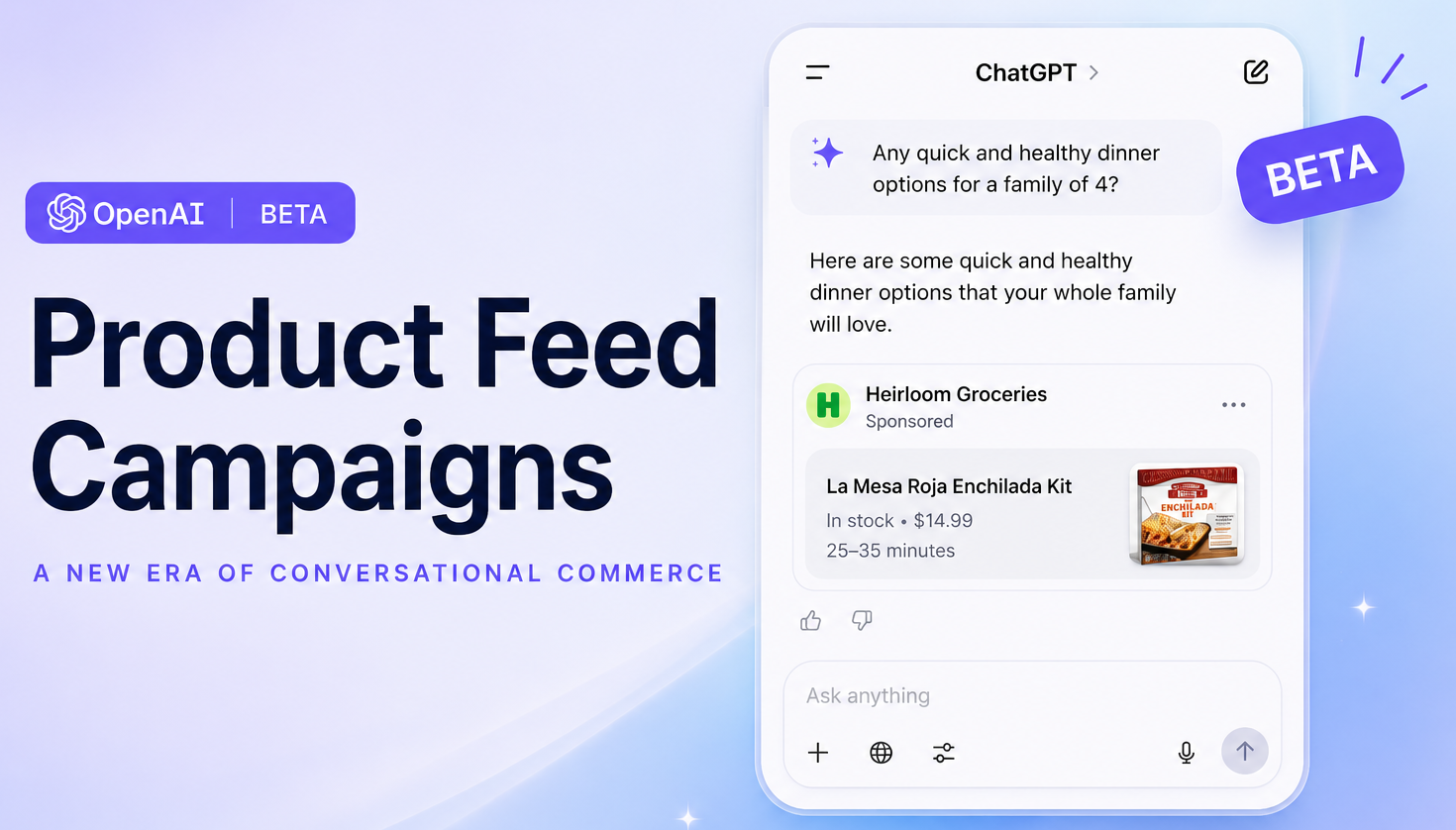
OpenAI’s Product Feed campaigns, now available in beta, allow advertisers to upload a product catalog and run ads directly from that feed. For retailers, this is an exciting step toward conversational commerce, but there are a few important details to understand before getting started. Before you begin, you'll need to fill out the interest form to be admitted into the beta. Note here the product feed minimum at this time (1,000 products).
First, don’t assume your Google Shopping feed can be copied over as-is. OpenAI has its own feed requirements, including attributes that differ from a standard Google feed. Taking the time to build a feed specifically for OpenAI will help ensure your products are eligible and properly understood by the platform.
Feed delivery can also be different. OpenAI currently requires product feeds to be uploaded via SFTP, which is worth noting for retailers that typically rely on API-based feed transfers.
Catalog size matters, too. OpenAI currently requires a minimum of 1,000 products and supports up to 2 million. Smaller retailers may need to wait until the minimum is lowered, while very large retailers may need to decide which products to include if their full catalog exceeds the limit.
Early feedback from OpenAI has been positive. The company has said, “Advertisers using product feeds have been among the strongest performers on the platform,” which is a promising signal as the beta continues to evolve.
A few additional things to keep in mind:
- Products from your feed are only eligible for paid ad placements during the beta. They do not currently appear organically in ChatGPT conversations.
- For more information on the organic ChatGPT conversations, see this blog for details on the web crawls.
- Each ad account is limited to one feed connection.
- OpenAI matches eligible products to user conversations that show purchase intent. Learn more about that here.
- Reporting is more limited than Google Merchant Center or Google Shopping. Current reporting is available at the campaign, ad group, and ad levels and includes impressions, clicks, spend, CTR, average CPC, average CPM, and conversions.
- Conversion tracking can be set up through the OpenAI Pixel, Conversions API, standard events, or custom events, but all conversion activity is currently aggregated into a single conversion metric.
- OpenAI supports static UTM parameters, but not dynamic UTM macros, so manual UTM setup is important for attribution.
OpenAI’s Product Feed campaigns are still early, but they represent an important new opportunity for retailers to show up where product discovery is increasingly happening: inside AI-powered conversations. Check out more basics here.