

The Generative Engine Optimization (GEO) Imperative
To prepare your product catalog for AI search engines, we recommend Bing Webmaster Tools and Bing Merchant Center as your diagnostic testing ground--primarily because they are the first to offer an AI Performance Dashboard, for free, that is available now.
VersaFeed is constantly fielding queries like "how do I get our products into ChatGPT" (or Gemini/Grok/Anthropic/etc). While the largest enterprise clients may get an invite to test ads, that is rare in Q1 2026--for most clients, prepare for the future by using the AI Performance section within Bing Webmaster Tools. This gives ecommerce companies a low-risk head start on Generative Engine Optimization (GEO) without waiting for Google to release their own tools.
Why Bing is the Ultimate AI Testing Ground
Bing has the query volume and the (newly released) AI dashboard, so it's a great "first stop" in prepping your data. AI engines don't just read basic product titles; they can instantly parse every deep product attribute (like exact GTINs, granular materials, and precise sizing) to answer complex, conversational user prompts. If your feed is sparse, AI engines will simply ignore your products.
A Step-by-Step Guide to Using Bing Diagnostics
Use these two specific Bing tools to identify gaps in your product attributes right now.
1. Track Your GEO KPIs with the New AI Performance Dashboard
This is big: up until recently, tracking generative search success was a guessing game. That changed in February 2026 when Microsoft launched the AI Performance Dashboard in Bing Webmaster Tools. This is the first native, enterprise-grade GEO tracking tool provided by a major search engine!
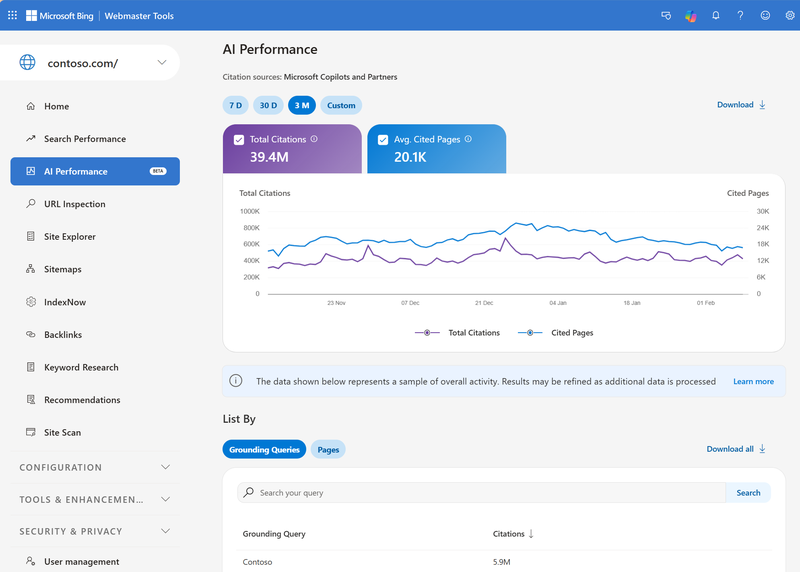
- Use this dashboard to track your Total Citations and Grounding Queries. When you enrich a product's feed attributes (like adding specific materials or exact dimensions), monitor this dashboard to see if your product pages begin surfacing more frequently in Copilot’s AI-generated answers. It provides the exact KPIs you need to prove the ROI of your AI readiness strategy to your executive team.
2. Run Structured Data Validation Reports
In addition, take a quick look at your structured data: AI models rely heavily on structured data (schema data embedded in your PDPs as microdata or JSON-LD) to understand context. If your feed and your site's schema mismatch, LLMs may lose confidence in your data and drop your products from generative answers.
- Use Google's Structured Data Validation tool to ensure that core product attributes are being surfaced like title, price, availability, and other core metrics.
Reactive Feed Management vs. Proactive AI Readiness
Here is how the old way of managing feeds compares to an AI-ready strategy:
| Feature | Reactive Management (Old Way) | AI-Ready GEO (New VersaFeed Way) |
| Attribute Optimization | Manual spreadsheet uploads and rules | AI-enriched titles and descriptions |
| Error Resolution | Firefighting disapprovals after they happen | Proactive gap identification via Bing diagnostics |
| Performance Testing | Guessing which title format works best | Multivariate A/B testing of feed attributes |
How VersaFeed Automates Your AI Readiness
VersaFeed helps enterprise companies prepare their data for the upcoming AI shopping revolution. If you want to ensure that your products are being surfaced in generative AI prompts, utilizing the above techniques in Bing’s AI Performance Dashboard is a huge first step, but there are MANY other steps that VersaFeed can take to prepare your data for the changing AI ecommerce landscape.
The transition to AI search doesn't have to mean more manual work for your operations team. Let us do the heavy lifting so you can focus on strategy.
Ready for a customized AI product data plan? Reach out to our team today to request a custom feed audit and discover how VersaFeed can automate your catalog's AI readiness.
Request Demo Get Pricing